Mass Spec Analytics.
One Enterprise Solution.
Our Customers

































Genedata Expressionist® streamlines biopharma mass spectrometry workflows across instruments and organizations. It automates and harmonizes all MS data processes to deliver high-quality results with significant time and cost savings.
We especially appreciated the high level of expertise and support provided by Genedata, which enabled us to optimize every stage of our analytical processes—while incorporating industry best practices—and quickly generate high-quality results.

Working with Genedata Expressionist provides us with fast, flexible, and reliable options to discover potential biotherapeutic liabilities and thoroughly analyze next-generation antibodies at Sanofi.

Genedata Expressionist provides high-quality qualitative and quantitative results and its flexible workflow-based approach makes it the ideal platform for processing and analyzing MS data generated using our innovative methods.

Performing preprocessing using Genedata Expressionist delivers a tenfold acceleration in file loading times. High-throughput host-cell protein analysis simply doesn’t work unless you have an efficient automated data processing and annotation workflow.

Oligonucleotide therapeutics bring new challenges, and we needed a trusted partner who could assist us in addressing them. We appreciated that Genedata offered more than just software and that the customized solution — particularly the automation — was exactly what we required.
I really enjoy performing data analysis with Genedata Expressionist, because I know that if the automated workflow needs fine-tuning for a specific therapeutic protein, its flexibility will enable me to easily make the required changes and quickly obtain the results I need.
Automated data processing and report generation provide remarkable time-savings in all our MS-based biopharmaceutical
characterization applications.
We needed something that enabled higher throughputs than the vendor software package we were using, so we turned to Genedata Expressionist. We can give Expressionist hundreds of files, and it is able to process them in a very quick manner.

Genedata developed the end-to-end oligonucleotide QC data workflow and provided the consulting expertise throughout the entire project including the validation stage to help us achieve our goals on time and within budget.
By reducing analysis time from 5–6 hours to less than 30 minutes per sample, Genedata Expressionist enabled us to overcome a major bottleneck in our analytical support of process development.

Using the custom library functionality in Genedata Expressionist streamlined our characterization workflow: reducing analysis times from several weeks to hours, and enabling us to progress quality candidates more rapidly.

All Applications. Any Instrument.
One Platform.
Offering complete integration across instruments, laboratories, and organizations, Genedata Expressionist streamlines and automates MS-based biopharma applications and delivers reproducible, high-quality results while eliminating costs for training and maintenance of multiple software packages.
Advanced data workflow management capabilities break down data barriers, facilitating global collaboration, and harmonizing analytical processes within organizations. Integrated user role and method management—in combination with electronic signatures, data traceability, and audit trails—smooths deployment in standardized and regulated environments.

Max Productivity. Complete Automation. Total Transparency.
Cutting-edge algorithms and a high-performance server-based infrastructure accelerate processing of data sets of all sizes and complexity, increasing productivity by orders of magnitude.
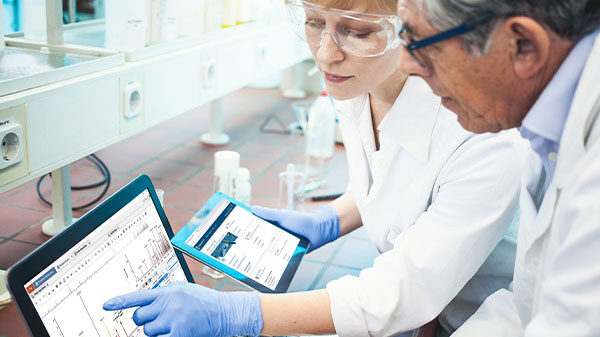
Automation of repetitive and laborious procedures overcomes data processing bottlenecks while configurable workflows offer complete control of every single processing step. Unique and intuitive visualizations enable data interrogation and facilitate interpretation and understanding of results by linking raw and processed data.
Tailored Solutions. Deeper Insights. Better Decisions.
A thorough assessment of your analytical processes enables our scientific experts to design and implement ready-to-use workflow solutions that address your specific needs. By incorporating consolidated domain knowledge, and out-of-the-box performance, Genedata Expressionist workflows allow rapid transformation of complex MS data into actionable insights.
From discovery to manufacturing, our unique approach provides a solution that leverages industry best-practices and users’ expertise to enable better decision-making.