All Assays.
One Digital Platform.
Our Customers

































Genedata Screener® automates assay analysis, validates raw data and assay result quality, and consolidates assay information across the enterprise and external collaborators. By integrating and condensing complex experimental data, it powers project decisions and lays the foundation for more predictive, AI-driven, drug discovery and development.
Genedata Screener is a great piece of software that makes MS data processing and analysis super-fast. Its visualizations are fantastic, enabling me to explore everything from detailed mass spectra all the way to plate level analyses

Genedata Screener is flexible and scalable, satisfying all our needs for high, medium, and low experimental throughputs

We believe that Genedata Screener is the gold standard for screening data analysis.

Genedata Screener is one of the standard screening platforms for many of our pharmaceutical customers.

Genedata Screener helps us to access unexplored biology that can’t be examined any other way.

Unify Analysis into One Platform.
In Genedata Screener, bring together results for any therapeutic modality—including for biotherapeutics and small molecules—or disease area into one place. Screener covers an unparalleled number of assay technologies with scientifically validated solutions and lets you centrally specify workflows ahead of time, helping harmonize your analysis. Automated reporting and data management with Screener ensures result availability and findability.
- Streamline workflows using one analysis platform for all instruments and technologies.
- Collaborate internally or with CROs and external partners using data securely shared on internal servers, hosted servers, or in the cloud.
- Optimize decision-making by standardizing reporting to data warehouses and annotating results with controlled vocabulary to enable future querying and interpretability.
Shorten R&D Cycles. Do More.
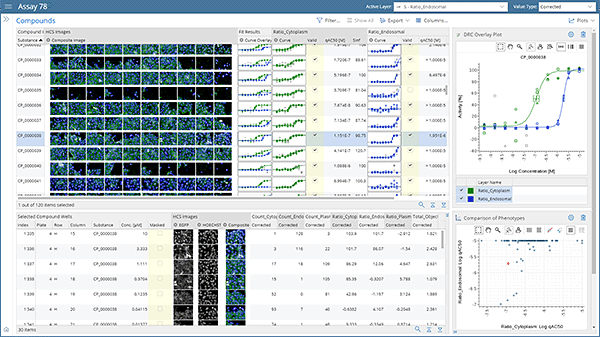
Genedata Screener helps you scale up assays and their analysis so that you can accelerate discovery. In just minutes, this powerful software handles huge or complex datasets by automating data capture, routine calculations, and multi-level quality control.
- Instantly initiate analysis upon experiment completion, using raw data imported directly from the instrument via one of our many standard integrations and plate information via our intuitive import wizards.
- Optimize assays for production-scale execution, with rapid on-the-fly adjustment of processing steps and functionality for comparison of different assay conditions and runs.
- Get straight to final per-molecule results with automated analysis and home in on promising leads from the get-go, using sophisticated assays enabled by Genedata curve-fitting, model selection, and multiplexing capabilities—at scale and early in the discovery cycle.
Ensure Data Quality.
Advance Your Science.
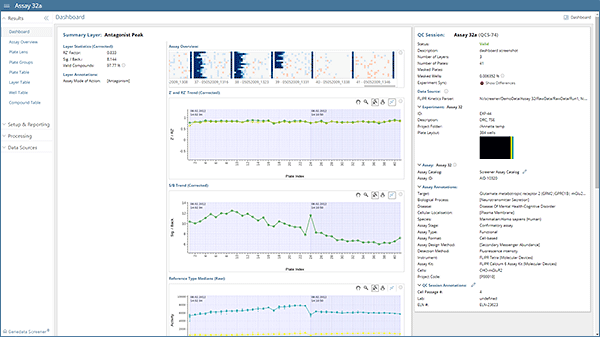
High-quality, reliable results are integral to successful research. Genedata Screener enforces standard QC criteria, pinpoints experimental problems, flags suspect data, and lets you inspect results and optimize analysis parameters as required—automatically recalculating any affected results across the entire dataset. Screener also incorporates knowledge from the forefront of science, putting the most current analysis methods at your fingertips.
- Reduce manual errors and interpretation mistakes.
- Enforce best-practice, scientifically-sound analysis rules using built-in business logic and advanced fitting algorithms and data models.
- Interactively and flexibly perform additional QC using clear, intuitive, dynamic visualizations.